
Contents:
Construction detailing has grown more complex, more performance-driven, and more interdependent. Energy codes evolve. Climate responsiveness is no longer optional. Material systems vary across regions, manufacturers, and procurement strategies.
Yet in many firms, construction details still live as static files in folders labeled “typical” or “archive.” A construction detail library should not function as storage. It should operate as an intelligent technical infrastructure, preserving validated solutions, capturing performance logic, and maintaining traceability across projects and teams.
While envelope detailing often carries the highest performance risk, a construction detail library extends well beyond exterior assemblies. It also governs interior partitions, finish interfaces, ceiling transitions, stair conditions, specialty fabrications, and other recurring systems that shape constructability and consistency throughout a building.
When detail knowledge is scattered across legacy drawings and informal reuse, inconsistencies arise. Performance assumptions drift over time, outdated standards resurface, and transition logic weakens.
As projects demand greater precision, the cost of imprecision at the detail level increases. A missing thermal break, a misaligned waterproofing layer, or an outdated fastening strategy can undermine performance long before coordination issues appear in drawings.
Firms that structure their construction detail libraries as governed, assembly-driven systems build resilience into their documentation process. They reduce variability without slowing production and transform detailing from drafting output into institutional knowledge infrastructure.
Many firms invest significant effort in building an internal construction detail library. Files are categorized by discipline. Naming conventions are standardized. Folders are structured by wall types, roof types, or project phases. On paper, the system looks organized.
In practice, however, these libraries often function as well-structured storage, not as active technical systems. Architects still search manually. They open multiple legacy files to compare variations. They copy details from previous projects because it feels faster than navigating the library.
When a construction detail library lives outside the active design environment, it becomes passive. It stores information but does not guide decisions. Over time, adoption rates decline. Teams revert to familiar project archives, while validated details remain unused due to the interruption required for retrieval. As a result, the library becomes a reference of last resort rather than a practical working tool.
An advanced construction detail library operates differently.
It is:
Most importantly, it connects directly to the design environment rather than existing alongside it.
When details align directly with building assemblies, architects can apply validated solutions within the design environment instead of manually searching archived drawings. The library becomes context-aware, and it responds to what is being designed.
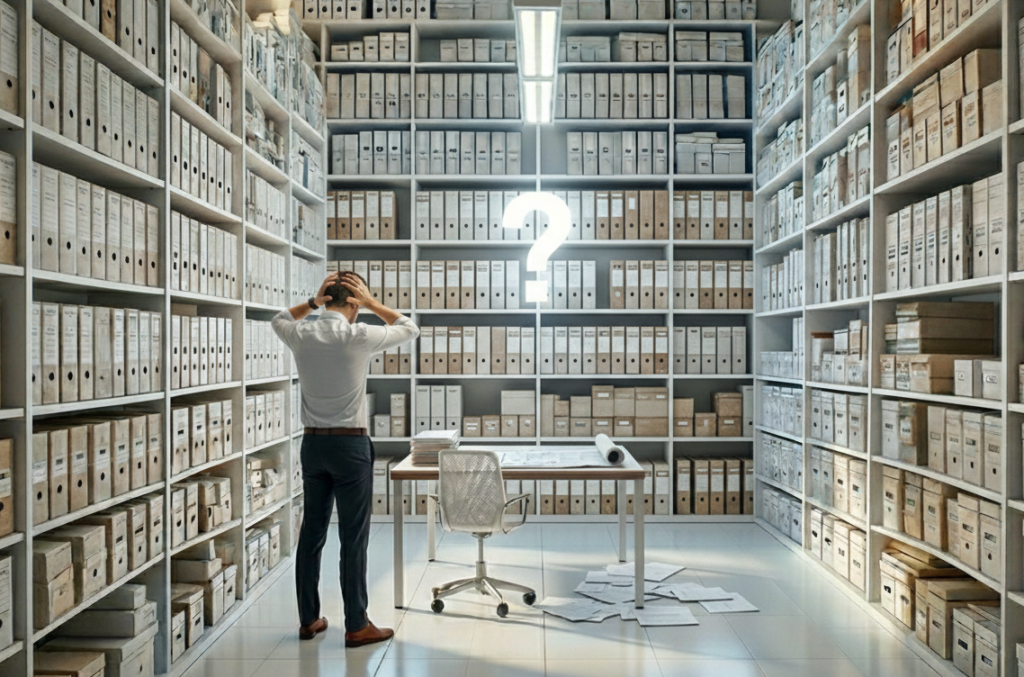
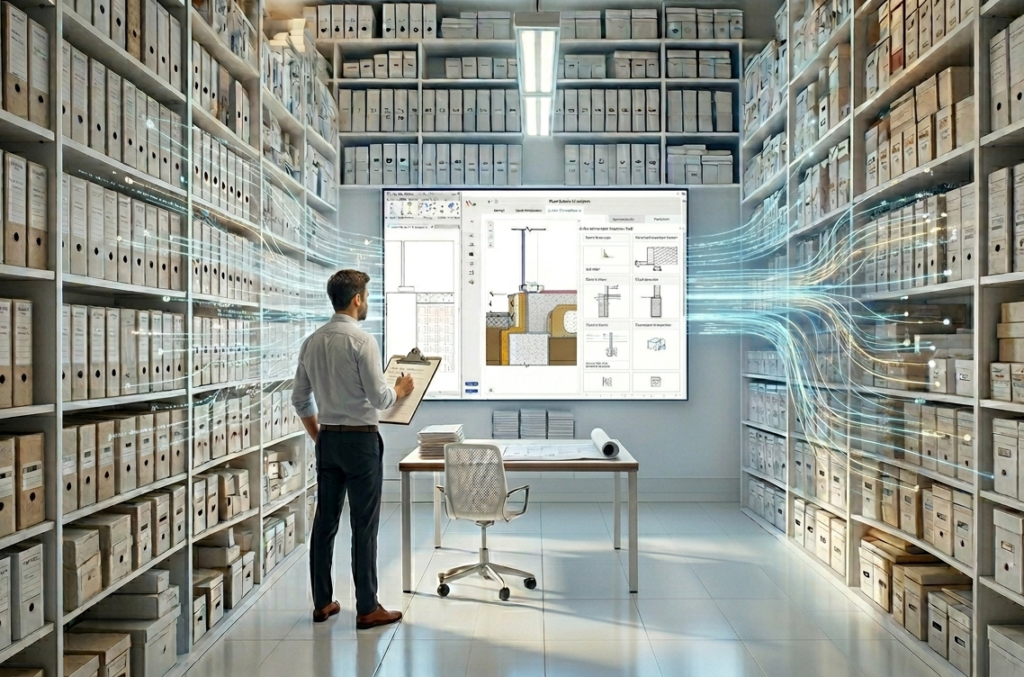
The distinction becomes critical:
As detailing grows more performance-driven and interdependent, systems that operate at the assembly level rather than the file level provide the clarity and consistency modern projects demand.
Most firms reuse details. While that is not inherently problematic, the risk emerges when reuse happens without structure, validation, or system context.
A common scenario is familiar. An architect recalls a similar condition from a previous project, opens an archived drawing, copies the detail, and adjusts dimensions. It feels efficient because it avoids starting from scratch.
But what often goes unseen are the embedded assumptions inside that detail.
When details are reused as isolated files, their relational logic is lost. The connection between adjacent assemblies, waterproofing continuity, thermal control layers, and fastening systems becomes fragmented. This is where technical drift begins.
Over time, firms accumulate hundreds or thousands of legacy details. Some are partially updated, while others reflect outdated standards. Without traceable validation or clear ownership, teams cannot confidently determine which version represents the current best practice.
The result is not immediate failure. It is a gradual inconsistency.
Two project teams may produce slightly different solutions for the same condition. Transitions between assemblies may not align perfectly. Performance intent may rely on undocumented assumptions. These issues rarely surface during drawing production. They surface later during coordination, submittals, or construction.
Unstructured reuse also creates invisible technical debt. Each copied detail introduces another version into circulation. As duplication grows, control weakens. File-level reuse also breaks the relationships between assemblies. Once a detail is copied into a new drawing, its original context—including adjacent systems and performance assumptions—is often lost
Advanced detail system reduce this risk by:
When details are structured as part of an interconnected system rather than as standalone drawings, reuse becomes deliberate rather than habitual.
In increasingly performance-driven projects, informal reuse is no longer a minor inefficiency. It is a governance risk.
If a static archive stores files and an active system supports decisions, the next question becomes practical. What actually makes a construction detail library intelligent? The difference is not in visual quality. It is structural logic. Much like how organizations such as the Construction Specifications Institute (CSI) formalized classification systems to bring order to building information, an intelligent detail library relies on clearly defined structural logic rather than informal file grouping.
An intelligent detail system is built on four foundational components.
Most traditional libraries categorize details by sheet type or discipline. While useful for filing, this approach does not reflect how buildings perform.
Intelligent systems organize details according to assembly and transition logic. This includes exterior wall assemblies, roof-to-wall transitions, foundation interfaces, and curtain wall edge conditions, as well as interior partition-to-slab connections, ceiling-to-wall interfaces, stair and guardrail anchorage conditions, and finish transitions at floor-to-wall intersections. Together, these recurring conditions form the structural backbone of a well-managed detail library.
This assembly-based structure preserves relationships between components. It recognizes that a parapet detail is not just a drawing; it is the intersection of waterproofing, structure, insulation continuity, and attachment strategy.
Building failures rarely occur within isolated components. They occur at transitions where systems intersect. An intelligent construction detail library should prioritize these high-risk interfaces rather than treating details as standalone elements. It organizes validated details around recurring transition types that require coordinated technical control.
Typical transition-focused structuring may include:
By grouping details around these interface categories, the library preserves the relational intent between assemblies. Transitions are addressed systematically rather than recreated from memory on each project, establishing a framework for managing recurring, high-impact interfaces with validated logic.
When combined with assembly-based organization and metadata tagging, this structure ensures that technical intent remains consistent and traceable across projects.
Folders alone cannot carry performance intelligence. An intelligent construction detail library includes metadata such as:
This allows architects to retrieve details based on performance context rather than file names. As regulatory environments and material technologies evolve, metadata becomes critical for maintaining accuracy over time.
Without governance, even well-structured libraries degrade.
A structured system defines:
Each detail carries a validation status. Teams know whether a condition reflects current best practice or requires review. This prevents uncontrolled duplication and preserves technical accountability.
When assembly logic, transition mapping, metadata, and governance work together, a construction detail library stops behaving like a repository. It begins functioning as a structured technical infrastructure.
Details are no longer isolated drawings. They become interconnected assets tied to building systems, performance criteria, and contextual applications. As projects increase in complexity, only libraries built at this structural level can maintain consistency without slowing down design production.
Even the most carefully designed detail system will lose effectiveness without active stewardship. Detail libraries do not fail because they are poorly organized. They fail because they are not maintained.
Over time, codes evolve. Manufacturers revise specifications. Climate requirements shift. Internal best practices improve through lessons learned in the field. If those updates do not flow back into the library, the system quietly becomes outdated.
Governance is what prevents that drift.
Every construction detail library requires a defined responsibility.
Without ownership, updates happen inconsistently. Teams may modify details locally for a specific project, but never formalize the change within the broader system. Clear accountability ensures that improvements become institutional knowledge rather than isolated project adjustments.
Libraries should be reviewed at defined intervals, annually or aligned with major code updates. This review process typically evaluates:
When review cycles are built into firm operations, the library evolves deliberately rather than reactively.
A construction detail library should not function solely as a storage system. When managed strategically, it becomes a structured environment for firm-wide QA/QC at the knowledge level.
Rather than relying solely on project-level review cycles, firms can embed technical validation directly into the detail library itself. Validated assemblies, approved transitions, and performance-tested solutions become the baseline for project teams to work from.
In this way, QA/QC shifts upstream. The library becomes the mechanism for consistently distributing best practices across teams, reducing reliance on individual oversight during each project cycle.
Most firms have decades of accumulated details. Not all of them should remain active. A mature governance strategy includes:
This reduces technical debt and strengthens clarity across teams.
Governance should not rely solely on memory or manual tracking.
As libraries become more digitally integrated, validation status, revision history, and applicability context can be embedded directly within the detail system. When architects can see whether a detail is current, superseded, or climate-specific at the moment of use, compliance becomes easier to maintain.
This shifts governance from a periodic administrative task to a visible, ongoing process.
A construction detail library is not a one-time organizational effort. It is a living technical framework that requires continuous refinement.
Firms that treat library maintenance as strategic infrastructure rather than background administration preserve consistency as they scale across teams, offices, and project types.
As design environments become increasingly model-based, construction detail libraries must move beyond external repositories. Modern systems connect detail intelligence directly to building assemblies within the design environment
As design environments become increasingly model-based through Building Information Modeling(BIM), as defined by the National Institute of Building Sciences (NIBS), detail libraries can no longer operate as isolated repositories. They must interact with the building model itself.
Digital transformation in this space is not about converting CAD files to BIM objects. It is about embedding technical intelligence into the design environment.
Traditional digital libraries rely on user-initiated search. An architect types a keyword, filters results, selects a detail, and manually adapts it.
Despite having better search tools, it is still the user’s responsibility to interpret the context.
Advanced systems operate differently. Intelligent assembly-driven platforms can associate validated detail logic directly with model conditions, allowing firms to surface technical intelligence at the moment of design decision. Instead of asking, “What file are you looking for?” They interpret the design context and surface validated technical responses accordingly.
These systems associate validated detailing conditions directly with the relevant building assemblies in the model. The architect engages the building, and relevant technical solutions surface within that context.
This reduces dependency on memory and accelerates confident decision-making.
Model-aware detail systems recognize relationships between building components.
Assembly is not simply geometry. It carries information about:
When detail libraries operate at the assembly level, validated transitions and firm standards can align directly with modeled building conditions.
This integration changes how technical decisions are applied. Rather than selecting isolated drawings and adapting them manually, architects work within assemblies that already reflect coordinated performance logic. Validated standards become part of the modeling environment, maintaining alignment between assemblies, specifications, and documentation outputs.
The objective is not automation for its own sake. It is continuity, ensuring that detailing decisions remain technically consistent as models evolve. By connecting detail logic, performance metadata, and specification intent within the same environment, fragmentation is reduced and technical standards remain synchronized across deliverables.
Details function not as independent drawings, but as structured responses to defined building conditions.
As automation increases, governance remains critical.
Advanced digital libraries:
Automation does not replace technical judgment. It supports it by surfacing structured knowledge at the right moment. The goal is not to eliminate decision-making. Instead, it is to remove unnecessary friction.
When detail systems integrate directly into the design workflow, they reduce interruption.
Architects do not leave the model to search through external folders. They interact with building assemblies and access validated solutions within the same environment. This integration shortens the distance between design intent and technical execution.
As projects demand greater coordination across envelope performance, interior detail, structure, and sustainability requirements, only systems that operate at this embedded level can maintain both speed and consistency.
Digital transformation is not about digitizing drawings.
It is about structuring technical knowledge so it responds intelligently to the design context.
Firms that adopt assembly-driven, model-aware construction detail libraries position themselves for scalable precision, enabling institutional knowledge to be accessible exactly when needed.
An intelligent construction detail library should not exist solely for organizational satisfaction. Its value must be measurable. The impact of an intelligent system is rarely visible in a single drawing. It becomes evident across projects, teams, and time.
Instead of asking whether a library is “well organized,” firms should evaluate how it performs operationally.
Healthy reuse is not measured by how often files are copied.
It is measured by how often validated assemblies are applied without modification.
Key indicator:
When reuse happens within a structured system, consistency increases without sacrificing flexibility.
In unstructured environments, similar conditions often result in slightly different solutions across teams. A measurable outcome of a high-performance construction detail library is alignment:
Reduced variability strengthens firm-wide technical identity.
Another indicator is control over revisions. Can teams clearly identify:
When traceability improves, confidence increases. Architects spend less time questioning whether a detail remains applicable and more time on design refinement.
Advanced libraries reduce the time between recognizing a condition and applying a validated solution. Instead of searching, comparing, and manually adapting archived files, architects retrieve context-aligned assemblies directly.
Measured outcomes may include:
This acceleration does not compromise rigor; it reinforces it.
Perhaps the most important metric is resilience. When senior technical staff leave, or roles shift, does the firm retain:
Without a structured system, much of this expertise lives in conversations, redlines, or personal project folders. When experienced staff depart, the reasoning behind technical decisions often disappears with them.
An advanced construction detail library preserves this intelligence beyond individual contributors. The library system should also function as a shared domain knowledge platform, where technical rationale, performance context, and revision history are visible, not implied.
Over time, the system becomes a durable technical asset rather than simply a documentation tool.
The true impact of an intelligent construction detail library extends beyond productivity gains. It strengthens:
As detailing becomes increasingly tied to sustainability, constructability, and code compliance, firms that measure and refine their detail systems treat them as core infrastructure rather than background support.
Ask your team:
If more than two of these questions raise uncertainty, your library may be functioning as storage, not as technical infrastructure.
Construction detail libraries are often treated as background resources, folders maintained quietly behind active project work. But as performance requirements increase and project complexity accelerates, that mindset is no longer sufficient.
The library is not simply a collection of drawings. It is an intelligent system that captures how a firm builds, manages risk, and preserves technical intent across teams and time.
Firms that rely on static archives are prone to inconsistency.
Firms that build searchable repositories improve access.
Firms that structure libraries around assemblies, governance, and model-aware integration create durable technical infrastructure.
Whether governing exterior envelope transitions or interior system interfaces, the detail infrastructure establishes consistent technical logic across the full scope of building assemblies.
The difference becomes visible in how confidently teams make decisions, how consistently details perform across projects, and how effectively institutional knowledge is retained.
As detailing becomes more performance-driven, shaped by climate, code evolution, sustainability targets, and digital workflows, the detail library’s role expands. It moves from storage to strategy.
Organizations that invest in structured, assembly-driven, and digitally integrated detail systems are not just improving efficiency. They are strengthening the technical foundation of their practice. The future of detailing is not more files. It is a smarter system.
Ready to streamline your Construction Detail Library into workflow?
Discover how D.TO enhances your daily design workflows on D.TO’s key features page, or schedule a demo to explore them in more detail!!
