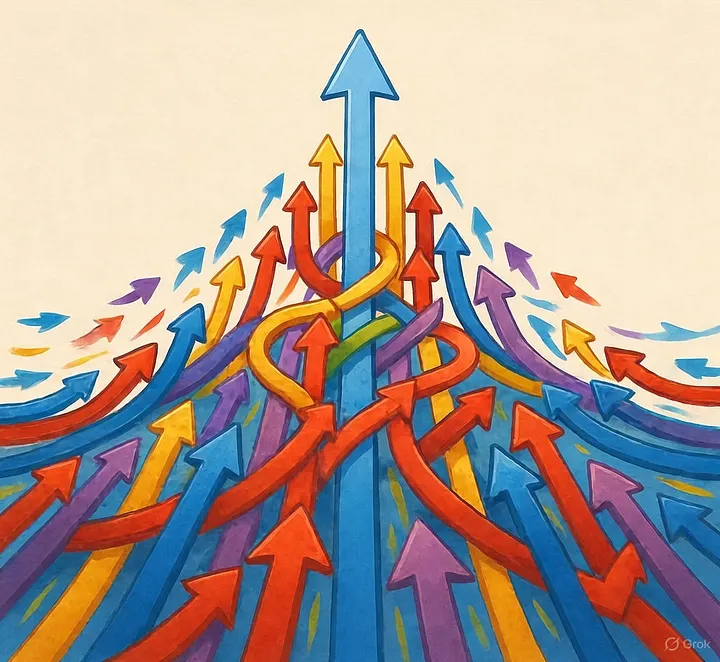
Convergence optimization, AI-generated (Grok) by D.TO, Dec. 2025
TL;DR: Divergence expands the space. Convergence chooses one defensible path. That means clear objectives, comparable evidence, sensitivity checks, and a named human who signs. Done well, convergence reduces rework, shortens review cycles, and makes envelope detailing, specifications, and drafting easier to execute.
Parts 1 through 3 covered problem first thinking, the friction of changing Tuesday’s workflow, and two kinds of divergence, parametric generative design and foundation model generative AI. Divergence gives breadth. Convergence moves the project by narrowing to a single, accountable choice that survives review, value engineering, submittals, and construction administration.
Explicit decision tree. The classic mode. Code checks, spec clauses, RFIs, and stepwise logic. If A then B. Traceable and repeatable.
Implicit pattern recognition. The expert’s memory. Recognizing that a rainscreen joint and insulation stack from a past facade fits today’s elevation. Powerful but opaque and hard to teach.
Modern automation can help both. Rules and checkers strengthen the explicit path. Retrieval and pattern learning surface useful precedent and turn tacit memory into something teams can actually compare.
Classic optimization shines when the objective is clear and constraints are complete. For envelope work that might be minimize thermal bridging while maintaining condensation safety and staying within an install cost band. Rigorous, but brittle if you optimized the wrong thing.
AI assisted search helps when objectives are messy. A model can score or rank candidates against multiple signals such as thermal continuity, vapor control strategy, air barrier continuity, fire stopping, acoustic attenuation, weatherability, maintenance, availability, and install sequence. It can recommend proven assemblies or details from precedent rather than inventing novelty. That is convergence by curation, not spectacle.
Objective hierarchy. Put aims in order for this decision on this project. If condensation safety outweighs a small U value gain, say so. If air barrier continuity ranks ahead of a minor aesthetic preference, say so.
Sensitivity checks. Nudge inputs that matter to building science and delivery. Shift climate zone assumptions, raise design dew point, tighten permissible thermal bridge factor, change product lead time, swap an equivalent membrane. See if the winner holds. If small changes flip the rank, the answer is fragile.
Human sign off. Automation informs and professionals decide. Record who approved, what they weighed, and two risks they accept, such as installation sensitivity or long lead specialty components.
The meeting is shorter. Slide one shows the objective hierarchy for the envelope zone. Each option gets one card with rule passes, two or three metrics such as U value segment estimate, psi value at a critical junction, and a vapor profile note, two photos of similar built work, and one risk note on sealant or maintenance. A small sensitivity table shows the winner does not flip under reasonable shifts. The approver signs. The detail enters documentation the same day.
Metric salad. Fifteen KPIs, none decisive. The hierarchy fixes this.
Vibe vetoes. Objections without a testable reason. Ask which metric or rule is being used.
Endless equivalence. If everything is good, your primaries are not discriminating. Sharpen them to building science priorities.
Late surprises. Adding a new warranty or sealant requirement after the decision. Capture it for the next cycle, not this one.
Checker theater. Running a tool for optics after the choice is already social. If it cannot change the outcome, do not pretend it can.
Convergence de risks delivery. It shortens the habit of one more round, prevents late rediscovery of moisture and continuity constraints, and stops option spam from leaking into coordination. That saves hours and reduces variance in construction administration. Whether those hours become profit, capacity, or client surplus depends on fee models and incentives, not only on tools. That is the next topic.
Will faster and cleaner decisions improve margins? We will look at lump sum, hourly, and target value fees, where convergence value accrues, and how to align incentives so better choices show up in the P and L.
Discover how D.TO enhances your daily design workflows on D.TO’s key features page, or schedule a demo to explore them in more detail!!
Written by Juhun Lee, CTO & Co-Founder of D.TO: Design TOgether
