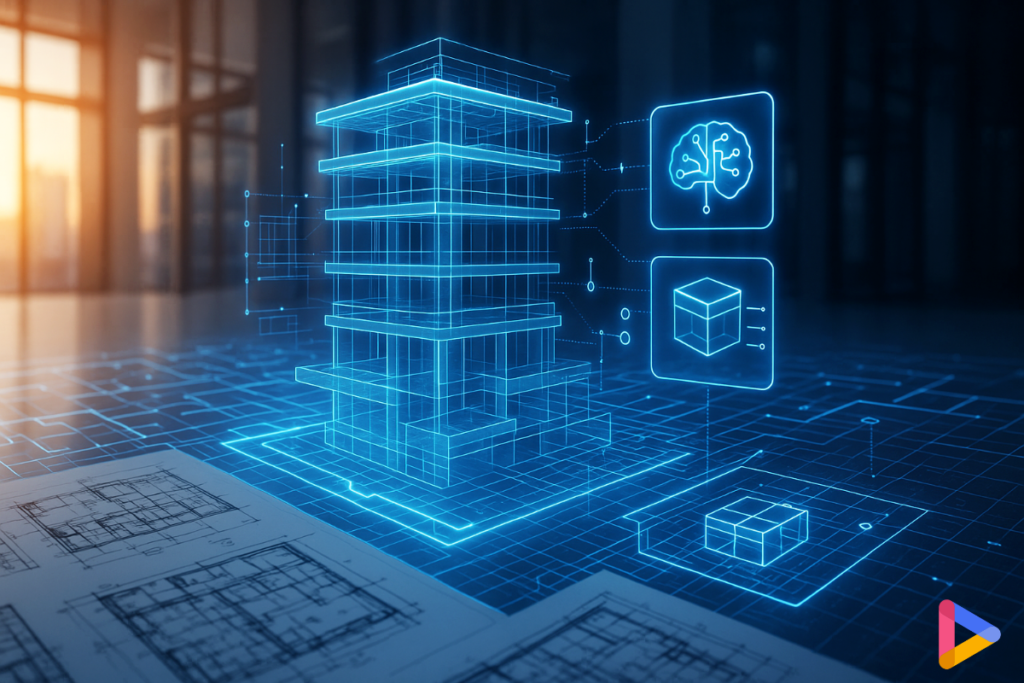
We’re moving from “draw and check” to “decide and verify.” Artificial Intelligence (AI) and automation don’t replace architects or builders. Instead, they broaden the aperture for what teams can see and speed up the routine checks that slow delivery. In a next-gen BIM workflow, models remain the source of truth while AI handles pattern spotting, risk triage, and consistency checks that keep information clean from kickoff to handover. Ultimately, it helps AEC professionals spend less time cleaning data and more time making design and delivery decisions.
Most AI in AEC is highlighted for generative design during schematic design for quick optioneering and fancy images. It is interesting, but the bigger payoff comes later during design validation in Design Development (DD) and Construction Documentation (CD), where intent must become buildable, and spec-aligned. Here, AI should act as a decide-and-verify co-pilot, not an autopilot. AI quietly checks context, surfaces risks, and keeps drawings, schedules, and specs telling the same story. Without this support, teams rely on late coordination meetings and manual reviews to catch issues that could have been flagged at the moment decisions were made.
Some teams are already applying this approach using purpose-built platforms like D.TO, which focus on validating constructability, continuity, and specification alignment directly within BIM-integrated documentation. The goal isn’t to automate design decisions, but to surface risks and inconsistencies early, while changes are still easy to make.
This later-phase focus sets up the next section, Automating Repetitive BIM Task, so human time goes to decisions while the system keeps the floor clean.
BIM automation delivers the most value inside the model environment, not in a maze of external spreadsheets, screenshots, and sidecar files. With AI supporting decisions across design phases, automation should bind drawings, modeled assemblies, and the systems they represent, so edits at the source ripple cleanly to tags, schedules, and specs without manual rework.
This kind of model-first automation works best when documentation logic, including details, schedules, and specifications, is governed in one system rather than stitched together across tools. Platforms like D.TO are designed around this principle, helping teams enforce consistency and standards at the source rather than relying on downstream cleanup.
This model-first automation sets the stage for using predictive analytics to prioritize risks and accelerate decisions, so coordination focuses on the few issues that actually block work.
Predictive coordination learns from past issues to forecast where clashes and sequence conflicts will occur by creating element-linked issues and nudging teams to resolve a small set of high-impact items before they appear.
All AI validations must be explainable (what failed, why, and a fix hint) and overridable with a logged rationale. AI is powerful and fallible. Treat it as decision support, not a decision maker. Don’t let speed shortcuts override life-safety checks.
For the big-picture roadmap of phases, exchanges, and approvals, see the BIM workflow guide. This AI/automation layer sits on that process spine.
Ready to streamline your BIM workflow?
Discover how D.TO enhances your daily design workflows on D.TO’s key features page, or schedule a demo to explore them in more detail!!
